

Although early telescopes resolved the Milky Way Galaxy into individual stars, we needed to measure the distances to and motions of these stars before a three-dimensional picture emerged: The band of stars has a depth, it encircles us, and the Sun and nearest stars are also within it.
The Milky Way Galaxy
On a clear, dark night, you can see a glowing stream that seems to split the sky. We have called it the Milky Way Galaxy for thousands of years, and its exact nature was a mystery until less than a hundred years ago.
Although early telescopes resolved the Milky Way Galaxy into individual stars, we needed to measure the distances to and motions of these stars before a three-dimensional picture emerged: The band of stars has a depth, it encircles us, and the Sun and nearest stars are also within it.
Like a chocolate chip in the middle of a cookie, its view is of a thin disk of cookie, other chips, and then space all around. Our Sun is one of hundreds of billions of stars embedded in a large disk.
By which element great Milky Way Galaxy formed?
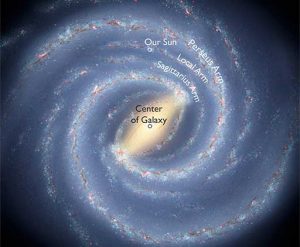
Elsewhere in deeper space, disk-shaped collections of stars are plentiful, and we refer to them as spiral galaxies. Spiral galaxies get their name for the alternating bands of bright starry and dark dusty gas swirls that pinwheel off of a bright, central core.
The arms of spiral galaxies are packed with gas and dust, and light-years of that material acts like a blanket the blocks our view beyond it. Radio waves can make their way through,
In the crowded conditions of star-forming regions in the Milky Way’s spiral arms, tightly-packed clouds of water and methanol molecules boost radio waves in the same fashion that a laser boosts light waves.
Like a sponge, these clouds soak up the incoming photons until their molecules are saturated with extra energy. Incoming photons innocently arriving into a supersoaked cloud cause an explosion of energy: As the first molecule spits out its extra energy, that energy triggers the neighboring molecule to also spit out its extra, and so on.
The picture we have now is the Milky Way Galaxy about 100,000 light-years across (a light-year being a distance of about six trillion miles). It has a few major arms: The Sagittarius Arm is closer to the Galactic center and the Perseus Arm is farther out in the Galaxy.


0 Comments